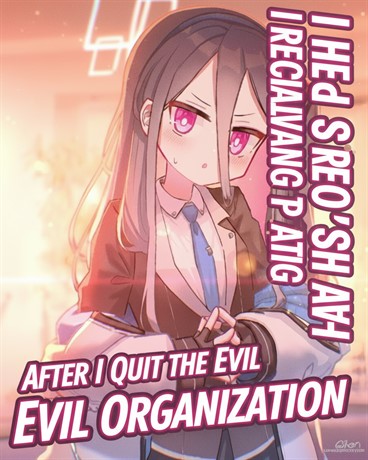
As the first combatant vaulted off the factory roof and barreled for Ivaris like a storm-loosed hawk, more silhouettes bled in from every edge.
On roofs, at window lips, inside steel ribs— even out of the churning sea.
They clocked the truth in a heartbeat: only two intruders. One of them sprawled on a beanbag like a cat in sun. Victory felt a foregone tide, and the only worry was who’d bag the headcount first. So they watched each other like wolves at a carcass and flowed toward the harbor in a fast, dark current.
Ivaris kept standing there, calm as moonlight on armor, watching the vanguard in his plated suit.
“You know the difference between a ‘combatant’ and a ‘warrior’?”
Her voice wasn’t loud, but it carried cleanly, like a bell across frost.
“Fighting’s just your job. In a fight, you count profit and what you’re eating tonight, so your first priority is to keep breathing.”
She pulled the Polaris Staff and twirled it twice between her fingers, a lazy feint like a swallow’s flick. She didn’t cast— Yekase had used it as a proper staff and a flying mount for ages, but the Polaris Staff was never built as a mage’s amplifier. Aside from that meager Passion Chant, its Sorcery throughput was no better than an iron bar.
Its real bite lived in the head, those iron tines that unfurled like a thorn bush under Flash Energy.
In short, a long-handled spiked mace, a winter storm on a stick.
Yekase called it barbaric and refused to use it, but Ivaris had demanded this feature herself.
A Magical Girl should brandish a mace.
“I ask you.”
“Have you ever stood at the front line of the human world?”
“Have you ever stepped into danger first, to shield another?”
“Have you ever felt your home vanish like ash on the wind?”
“No?”
“Then you won’t beat me.”
The last Magical Girl began to dance, like dawn shaking off frost.
She switched hands behind her back and let the Polaris Staff kiss the metal deck, a serpent at rest, then bit the tip of her tongue.
The straight-charging combatant flashed a thumbs-up, a sunlit gesture that also measures distance like a hunter sighting a deer.
She stepped in.
She pressed her bare, taut abdomen against the cold iron shaft, breath misting like steam.
She poured in centrifugal pull, arm strength, torque from waist and ankles. The T-pattern steel plate beneath her feet cracked in a lightning-shaped scar.
Then, with the poise of a cygnet cutting water, she swung the staff head.
Those thin, sharp, stubborn blades scraped parallel arcs into the floor, drew a full circle like a whirlpool taking hold, and clamped squarely onto the combatant’s side waist.
Thud.
A pure blunt impact, like a drum struck in a cavern.
His armor shattered, his spine broke; he flew like a torn rag, arcing ugly through the air and slamming into the poor fool behind him. They tumbled in a heap, two leaves caught in the same gust.
“I’m not like a certain someone— fussing to call herself ‘clerical.’ I was born to smash cowards like you.”
Right on cue, Ivaris opened with “I’m not like a certain someone,” and randomly @’d whichever teammate had blundered most recently. Aside from departures, only in moments like this did she look like a captain.
Then, tireless as a storyteller by a brazier, she’d keep introducing her moves to those exogenous entities as if they understood human words.
“This one’s called… ‘Fool God’s Hymn.’”
And Yekase in the monitoring room would say the same line, again and again:
“You’re just… normally swinging a stick, aren’t you?”
Ivaris reeled the head back in, flicked off blood like raindrops, and shouldered the staff in one smooth motion.
A swing honed to red-hot perfection after countless repetitions— still a swing.
Even if it’s faster, truer, crueller— still a swing.
“Next. Step up.”
The next combatant did step up, and was launched away in the exact same arc, like déjà vu written with iron.
Ivaris kept her levitating modules around Yekase as a shield. She didn’t even open the light blade at the tip of the Polaris Staff, saving energy like a lantern guarded in wind.
In modern-war terms, it was hell after all tech fails, burns, and breaks— two shattered sides, bayonets in trenches, mud up to the knees.
There are ways suited for hell.
From all directions, combatants poured toward the harbor like a black flood. Some carried guns of every make, some knew a few spells. Yet the moment their boots hit the steel deck, every gun jammed in eerie unison, like reeds snapping under frost.
The mages felt worse. Their Celestial Speech felt dead, like a cord yanked from the wall. They couldn’t cast the simplest spell.
How could that be?
Veterans smelled it at once. A field mechanic— the Special Zone fights broadcast live nationwide as reality TV. The Japan division of Shadow Curtain International was packed with old-school 2D otaku. After Reiwa began, they turned proxy wars into a “death game,” bolting on items and field effects like neon signs.
A rare neutral unit dying right away would be boring. So freebies felt normal, like spice thrown in late.
Some backed out, but more thought numbers could drown anything, like a tide over stones. Strangers from the same org grouped up, and in the end they sealed Yekase and Ivaris in tight, water won’t pass, air won’t pass.
But drown… drown who?
“By the way.”
Yekase sank deep in the beanbag, clearing mobile game stamina like a monk counting beads. Her posture was unguarded, her mood a lazy wind in a living room.
“What?” Ivaris asked, back to her, voice a spark before a strike.
“In death games, urban ability battles, you see that trope a lot. A character’s profile says he’s super strong, has some impossible skill, killed countless people. Looks like he can solo a thousand. He swaggers in, then gets killed by someone else who can also solo a thousand. Some die ugly.”
“There are always stepping-stone extras. What of it?”
“Those characters have colorful backstories, good enough for spinoffs as key supporting roles, even leads. But their casual deaths in the main line stick so hard that whenever you watch their spinoff and they pose, you remember their trash-fish panel at the end. It’s supposed to be cool, yet you want to laugh.”
Yekase set her phone on her chest and glanced at the ring of combatants, a storm about to break.
“I’m wondering how many of them out there are that kind of role.”
Blood spattered despite the shields, bright berries on steel.
“Even with barriers, how is there blood on the sofa? These covers are a nightmare to wash.” Ivaris frowned at a dark-red patch tucked into the back corner.
“Good news— the whole bottom is soaking in blood. We can toss it.” Yekase lifted the beanbag and revealed the sticky lake beneath.
“What?! I was trying to hit away from us!”
They agreed the beanbag was a lost cause and set it with the bodies, a grim bouquet under summer heat. They worried the whole district would stink by sundown, when a drone wobbled in like a lazy moth.
“Please don’t worry. Staff will arrive shortly to clean thoroughly.”
“Why is it a live operator right off the bat this time?”
Yekase tapped the drone’s shell. It flinched like a cat that hates being petted and slid to the other side.
“Your performance was spectacular. Our ratings hit an unprecedented 31.7%! As thanks, you may make one wish to Shadow Curtain International, Japan Division— anything at all!”
“Perfect. We need to find someone named Akano Souu. Take us to her.”
“…Would you like to think it over more? It’s the Japan Division’s one and only wish! Knowledge, power, wealth—”
“Coordinates. Now. If she dies because you’re late and our wish fails, how do you plan to compensate?”
Ivaris lifted the Polaris Staff in its original mode and made a few casual, threatening arcs in front of the camera. The drone popped two meters higher, panicking mid-air.
“I—I know! I’ll look it up right away!”
Minutes later, it said it had a lock and guided them onto a path leading deeper into the ruins, away from the harbor’s reek of death and iron.
Near a freight port, most buildings are warehouses and bureaus, no true neighborhoods. But as they walked toward the city, apartment blocks and commercial streets slid into view like gray cliffs.
They shared one thing— all worn-down, like a city after a long winter of people.
It looked like human decline, a picture left in rain. Time felt congealed, quiet and uncanny, a fog bank that never lifts.
Yekase knew that with combatants throwing down, quiet like this wasn’t normal. This area had been mapped and bled dry. The rest were either timid, cautious, or too far to make it. None of those types would stroll the road like sun-bathers.
“Is everything broadcast through drones? No fixed cameras?” Yekase peered around like a sparrow watching wires.
“…Yes! The field’s too big…”
That didn’t add up. With only drones, could they really catch every highlight? Miss one spark and the audience howls, the sponsors burn. What kind of reality show is that?
“So that means…” Ivaris began, a flake of iron in her tone.
Besides Crimson Field and the Dewa faction, staff are mixed in among combatants.
Which made it stranger. When rage hits, you swing at any card marked with the opposing house. Who has bandwidth to spot GMs in the crowd? Or have Japan Division’s rank-and-file sunk so low they play house with civilian orgs?
Reality show. Variety show.
A script?
“It’s all business,” Ivaris said, like a wind through bamboo.
“…Business.”
Yekase rolled that word on her tongue, tasted sweet and bitter, then laughed, soft as rain on slate.