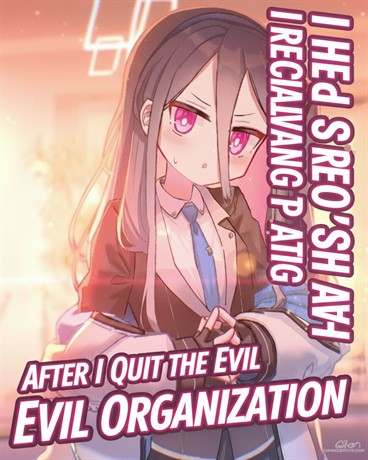
Yekase woke to a noon sun that pooled on the sheets like warm milk.
Fae was gone, a feather in the wind, leaving only a paper note like a fallen leaf.
It said:
[Then, I’m going to fall in love with the world again.]
Irritation surged first, hot as a coal; she dialed Sandryon and demanded why the brief had been so breezy, why she’d run headlong into the Iron Cross Knights and almost died in a foreign land.
“Huh? Iron Cross? So fast this time?” Sandryon’s voice floated over like a lark, light but prickly. “Even if you couldn’t take them, she should’ve hit that epiphany and gone berserk to clear out those zealots.”
The flippant tone landed like a pebble in her shoe—small, relentless—and Yekase almost slammed the phone to the floor.
“Fae’s my peer,” Sandryon added, a sigh like rain on slate. “They cast by instinct, a glorious mess. Instead of hoarding knowledge, they periodically wash their memory clean and roll their body into a random form, then meet the world from zero—he told me that last run and the run-before-the-run-before-that. In this run she bumped into you at the start, so maybe it’ll be a happier journey.”
The image hit like a lantern in fog: beating a brilliant game, then deleting your save to taste the first bite again.
A question rose first, soft as mist: If you lose your memories, are you still you?
She hadn’t thrown that at Fae, yet the answer now glimmered in Fae’s footprints.
Believing the soul can outfly memory…
…was a bard’s romance, a swallow skimming a spring river.
“The cycle’s exactly fifty years,” Sandryon said, voice like a ruler’s edge. “They call him the Half-Century Reincarnator. The Church calls it blasphemy, but I don’t know the standard. Anyway, thanks for the help.”
Dry worry crackled first, then words: “What if one or two had slipped away to report? How am I supposed to live in Europe after that?”
“Ah-hahaha…” The laugh fluttered like a paper fan, and died.
…
Later, Yekase learned the city had sealed shut like a clam under curfew; every door barred, every window an eyelid, and when the Iron Cross Knights entered, nobody dared claim a tie—bless that wizard hat like a curtain of fog—so not one witness truly saw her face last night.
Mira, meanwhile, was spending a sweet hour with a bestie she called “the cutest in the world,” and as one of the city’s rare Chromatic-class powerhouses, she didn’t even care about the ruckus on the square, like a cat ignoring thunder.
But that last magic cannon Yekase fired into the sky etched itself like a comet’s scar into many minds.
People didn’t dare guess the outcome; they only knew that Iron Cross squad didn’t linger. Church knights don’t let prey slip; maybe they chased the cannon’s master beyond the walls. Or maybe…
That blood-red pillar, like a spear through the heavens, soon got a tavern name: the Crimson Skyline.
Declaring war on the Church, moving in shadow, a hell-red beam like a demon’s horn—drunks mouthed off and flew too close to the sun, and barkeeps tossed many out into the night.
So the whole affair came like a squall and blew past like one. Yekase slept an afternoon, then, calm as a pond at dawn, went to the church for the Sovell Conference the next day.
Back in seven-year-old mode, her clothes fit like sails on a twig, so she flipped into Magical Girl form; the door checked for a dedicated earpiece, and a nun at the side entrance let her in, guiding her toward the back garden like a white moth leading the way.
She’d slipped in once to find Fae, but hadn’t looked around; now the place unfurled like a painted scroll.
The back garden was trimmed lovely, a winding path like a brook, flanked by flowers in every season, evergreen shrubs like mossy hums, and in the flowerbed’s depths, pines and maples spaced like constellations—sparse enough to spare the sun, dense enough to pour green into the air. Following the nun over the cobbled path, Yekase felt like a kid on a fall field trip.
“Uh, that statue is…?”
Her finger pointed down the path, to a figure beneath a great pine like a dark parasol.
An unremarkable-looking man stood straight on a plinth, right hand lifted at a neat forty-five degrees, holding a short cord with a round pan hanging, like a star-catcher’s tool. It didn’t match the church’s style, yet it radiated a strange gravity.
“That?” the nun said, her voice a quiet bell. “That’s the Blasphemer.”
“Blasphemer…?”
“They say he was one of the early rebels against geocentrism, who tried to chart the stars and prove the sun sits at the center of the universe. He actually drew the map and handed it to the Church. He was executed, of course.”
“Uh, but modern science has—”
“Of course. Modern science proved even the sun isn’t the center.” Her smile was thin as paper. “Church influence got carved up by the Sinister Organization; in the past, the Iron Cross Knights didn’t need secrecy. Dragging blasphemers from their homes for street executions was as common as rain.”
That… almost made you thank the Sinister Organization. No—thank modern science, like thanking dawn for ending a bad dream.
“Their punishment for him was this,” the nun said, gaze drifting toward the statue like a swallow wing.
“The Church’s Alchemists turned him into that statue, to warn every soul who comes here.”
“…Huh?”
Yekase jolted, like a twig snapping, and stared again.
A person? He had been a person?
“Their last mercy was letting him choose his pose,” she said, sorrow like smoke in her eyes. “So, under the glare of noon, he made this ‘observing the night sky’ pose. In the modern day, he instead became a symbol of scientific spirit, the figure every Infinite Power researcher bows to. In a way, he got his wish.”
Yekase nodded and walked to the statue, steps quiet as moths.
At his feet lay a simple plate, a name stamped like an iron brand.
[Heretic Who Challenged My Lord’s Authority]
[Fae Greenfield]
…
“…Pfft.”
So it’s you.
The heaviness fluttered away like a startled sparrow, and Yekase barely kept from laughing out loud.
After paying respects to the Blasphemer, she followed the nun to the Sovell Conference hall.
“Please enter. May the Lord’s wisdom fill you,” the nun said, her blessing like cool water.
Yekase nodded and stepped inside.
Half an hour before the start, over twenty people already sat within, most middle-aged men in black suits like a grove of ravens, straightening their speech drafts for the day’s agenda.
A little girl in a white sailor uniform appeared in the amphitheater classroom like a stray cloud. No one blinked.
It wasn’t that they didn’t see Yekase. They simply accepted it—inside this temple of knowledge, looks, clothing, age were fallen leaves on the path.
Her earlier worry lifted like fog in sun; she found her seat, then idly toyed with the triangular nameplate like a paper boat.
…
The Sovell Conference began like a steady tide and moved like one; at once, they focused on whether Neptune should be removed from Infinite Power, an academic heat that matched, even beat, Huaxia’s Alchemy exchanges.
Yekase stated plainly that Neptune is a species, and amid a rain of gasps, she cast her phone to the big screen; Rice Rice morphed between forms, like a jellyfish blooming and shrinking in deep water.
“Our criteria for Infinite Power need updating,” she said, voice a lamp in a windy room. “When we meet other energy life with self-will, we can’t repeat the Neptune mistake—”
“Madam, have you communicated with a Neptune individual—”
“Why would a hive-mind species develop without a companion evolution in Soul Power—”
The topic landed with a neat conclusion: Yekase would deepen her study of Neptune ecology, and everyone agreed to correct the misnomer of “Neptune Energy.” Unprecedentedly, they kicked one of the six Infinite Powers off the list, like pruning a crooked branch.
“Then, from now on, six Infinite Powers become five,” an elder announced, voice like a gavel.
“No need. One Infinite Power can take Neptune’s place.”
Yekase pulled a mineral-water bottle of red liquid from her bag and set it on the desk, the glass a tiny lighthouse.
Heads turned like sunflowers. The hands-on researchers caught the strangeness in an instant, and a few even rose, chairs creaking like old hulls.
That red energy—wasn’t it the very stuff of last night’s heaven-piercing beam on the square?
She scanned faces. Surprise flashed like lightning; curiosity gathered like clouds; and—fear pricked like brambles.
Cold dropped through her first, a trapdoor underfoot. Her breath snagged, then hissed; she froze.
Oh, crap.
I just outed myself.
A chill like a winter pond sealed around her. Her mind rang with a single note. She swept the hushed hall, pulse like a drum.
If they exposed her here, the name Yekase would weld to Magical Girl Icarus’s face in the Huaxia database; the lid would fly off worldwide. Europe would want her, and even back in Huaxia, bounty hunters would come like wolves for easy meat.
For safety, should she bare her fangs and cow the room—
“This brilliant young lady must have used last night’s incident to sense this Infinite Power’s existence,” the elder cut in, his tone a quilt of cover.
“Sharp academic nose,” someone said, like a toast.
“Courage worth respect,” another added, a steady flame.
…Huh?
They were handing her a ladder? They were shielding her with silence?
She looked again, unbelieving. Even those who’d flinched now met her eyes and nodded like elders blessing a child.
“Ladies and gentlemen,” the elder said, voice like an evening bell.
“Knowledge has no borders, no good or evil—but users do. Some of us belong to the Sinister Organization. Some invented cruel weapons of war. Yet right now, we sit here as researchers of Infinite Power.”
His white hair framed a smile soft as lamplight when he met Yekase’s gaze.
“I propose that within a limited time after this meeting, we keep this new energy for small-circle study by those present—until its young discoverer deems the moment ripe and spreads it herself.”
“This…” The promise felt airy, like a bridge of mist, and Yekase drew breath to speak, but assent rose around her like a tide:
“I support Mr. Burns.”
“Fully agree.”
“To prevent abuse while the nature’s unclear.”
“Science shouldn’t be shackled by faith!”
“Carry on Mr. Greenfield’s spirit.”
Her words dissolved like salt in rain.
Her mouth opened, closed; after a few beats, she managed a thin thread:
“Simulated true vacuum…”
She breathed out, then lifted the mic like a torch.
“Simulate true vacuum, fish a positron from the Dirac sea, give it mass with the Higgs field, then collide it with an electron under observation—you get Flash Energy.”
Rustling broke out like grass in wind.
“Madam, forgive me,” a scholar raised a hand, voice a curious flame. “If you publish this, you’ll own the flagship pages of every core journal…”
Yekase shook her head, a small wave. “The references are a headache, and I don’t want to write them. Also, if needed, leave your lab address after the session. I’ll mail a bottle of Flash Energy as thanks for today.”
“And your patent revenue?”
“First, I’m not the first to find Flash Energy,” she said, honesty like clear water. “There were scattered studies before me; they just didn’t make waves. They didn’t charge; I shouldn’t either. Second—”
She broke into a shy smile, sudden as sun through cloud.
Only then did everyone really see it: the discoverer looked almost too young, like spring wrapped in a lab coat.
To them, the little lady seemed new to the center of the stage, a touch flustered, cheeks blooming with a faint blush as she said:
“Because I’ve always believed that the birth and growth of science is for human happiness.”
That afternoon, light lay over the Sovell Conference like a still lake. Even the researchers there—the world’s staunchest materialists—were swept by a brief daze, as if an angel had stepped into view.